
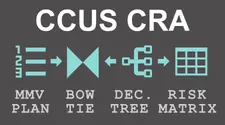
Quintessa has developed a methodology for containment risk assessment for Carbon Capture and Storage (CCS) projects based on over 30 years’ experience working on CCS demonstration projects, planning for commercial projects and funded research projects. Since 2021 Quintessa has used this experience to support UK-based CCS projects as they move through the process of applying for a Carbon Storage Licence and a Storage Permit. Our aim is to follow a structured process which enables regulatory submissions to be successful the first time and allows for iterative updates as a project matures. The application of a structured approach with associated good decision making saves time and cost in the long term.
Introduction
Quintessa has a long track record of working on containment risk assessment for CCS, having been involved in the EU-supported Weyburn, CO2REMOVE and RISCS projects. In the Weyburn Project, Quintessa developed a widely-used database of Features Events and Processes targeted at risk assessments for CO2 storage. In CO2REMOVE, Quintessa led development of an integrated decision support tool to connect performance prediction and monitoring with risk assessment methodologies. This involved work on the In Salah and Snohvit CCS projects. In the RISCS project, Quintessa worked on defining credible impact scenarios for CO2 leakage and on quantification of those impacts. Quintessa also undertook one of the first risk assessments for a CO2 storage project in the UK – the White Rose project (now NEP’s Endurance Project) as part the UK governments 2016 drive to implement CCS. Quintessa has also supported development of risk assessment methodologies for CO2 storage in Japan, during several projects spanning over 20 years.
Risk Assessment Methodology
Quintessa’s risk assessment methodology draws on this significant experience alongside international guidance on best practice in risk assessment (ISO standards). The methodology allows for consistent, transparent and traceable assessment of risk, using multiple lines of evidence and staying abreast of the current guidelines. The stepwise approach is illustrated in the figure below. It allows for recording decisions and judgements with flexibility to include a range of qualitative, semi-quantitative and quantitative risk assessment techniques from workshops to FEPS, bowties, decision trees, scoping calculations etc.

Recent Application of the Methodology
In the UK, when applying for a Carbon Storage Licence, operators must as a minimum discuss the major risks to storage, highlighting data gaps and further studies. If awarded a Carbon Storage Licence, the operators must then undertake a series of risk assessments: Early Risk Assessment; Preliminary Risk Assessment; leading to the Containment Risk Assessment which is submitted with the Storage Permit Application.
Quintessa is supporting Spirit Energy through this process, contributing to the successful award of Carbon Storage Licence CS010 for the North and South Morecambe fields as well as writing and updating the Early Risk Assessment in the Appraise Phase of the project.
The structured approach with clear documentation has been received well by the North Sea Transition Authority (NSTA), which is responsible for awarding Carbon Storage Licences on the UK Continental Shelf (UKCS). This has allowed smooth progress for the risk assessment work.
Early Risk Assessment Reviews
In the UK, as part of the Appraise Phase of the Appraisal Term of a Carbon Storage Licence, operators must develop an Early Risk Assessment and bring in two external technical experts to review the assessment and provide feedback both to the operator and to the NSTA. Quintessa has undertaken this role for ten Carbon Storage Licences in NSTA's Licencing Round 1, including CS001 which has been successfully awarded a Storage Permit. Our review is based around our risk assessment methodology. We provide constructive feedback on improvements to the assessment methodology and documentation, ensuring that assessments are backed up with clear justification, with the aim of supporting operators in meeting the NSTA’s requirements. We acknowledge the early stage of the work and advise on further work that would be helpful. Both operators and the NSTA have found Quintessa’s inputs helpful and constructive.