
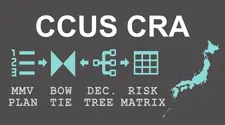
Quintessa has supported QJ Science in its work for the Ministry of the Environment, Government of Japan (MoE) to develop a risk assessment methodology targeted at CCS in Japan.
For underground CO2 storage to be implemented safely and effectively, rigorous and robust risk assessment methodologies are needed. These methodologies must meet the requirements of international guidance such as ISO 27914:2026 Guidance on Geological Storage of Carbon Dioxide
, and to this end, several methodologies have been developed in different countries. Risk assessment methodologies for CO2 storage in Japan must account for features of Japanese geology that differ from those of most other countries where CO2 storage is being promoted. Especially, consideration needs to be given to seismicity that reflects Japan’s location straddling four tectonic plate boundaries, and to the relatively young and therefore less consolidated Neogene sedimentary rocks that constitute many potential CO2 storage reservoirs and caprocks. These rocks also typically contain high proportions of relatively reactive volcaniclastic material, reflecting the active volcanism that occurs along the Japanese archipelago. Another relevant feature of Japan is that there are no extensive evaporite (especially halite) deposits, unlike in potential CO2 storage sites in areas of the world such as the North Sea offshore from northwest Europe. A consequence is that Japanese formation waters generally have relatively low salinities (typically similar salinity to seawater). Considering these characteristics, Quintessa has developed a framework for rigorously assessing risks of CO2 leakage from future Japanese storage sites and the risks of unacceptable induced seismicity. The framework uses systematic analysis of Features, Events and Processes (FEP), decision trees developed in Quintessa’s TESLA software, Bowties and risk matrices.

If you are interested, please sign up to receive Quintessa’s biannual CCUS newsletter.